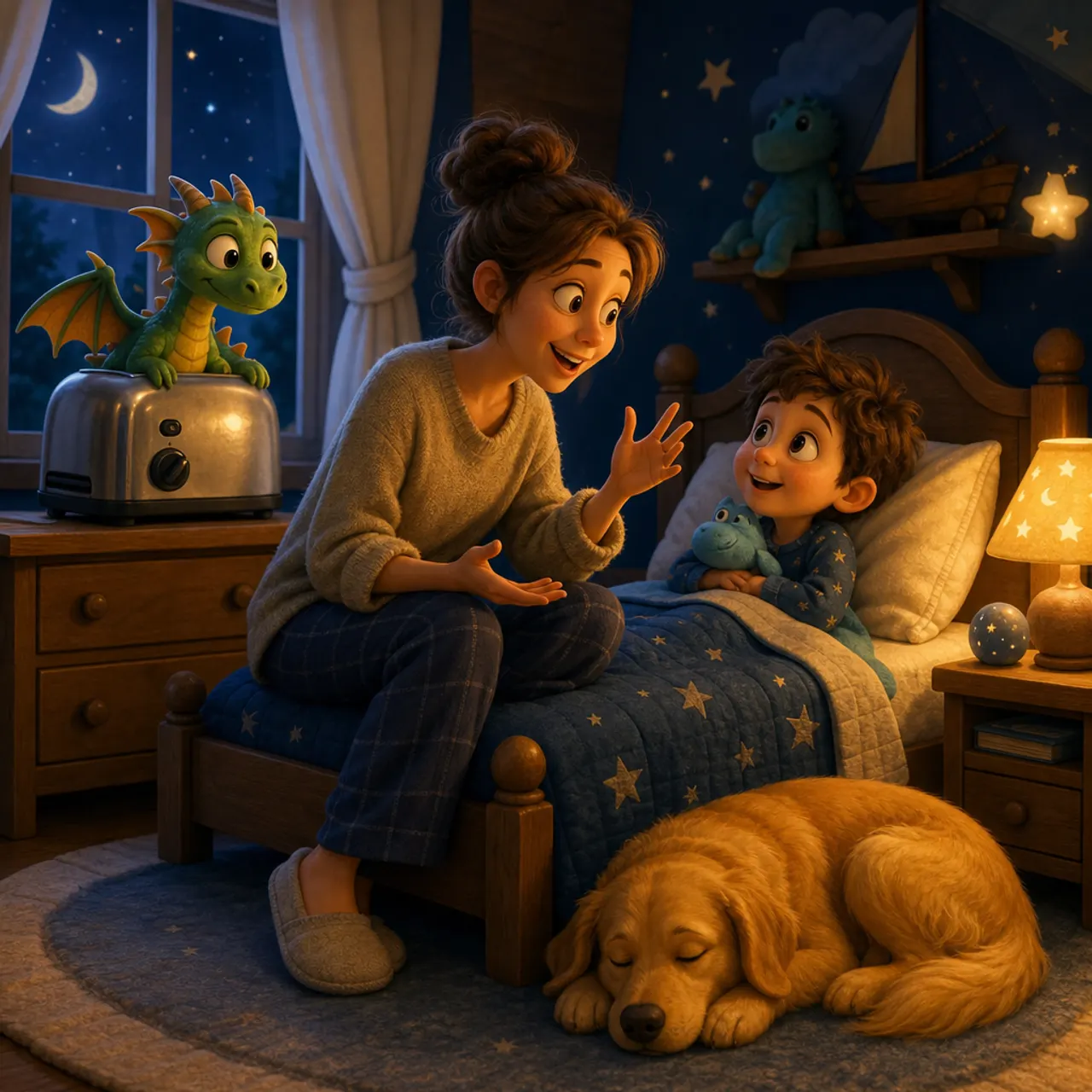
It's 7:50. The books are in the car. Or you've read all of them. Or you've read one of them so many times you've started resenting a fictional rabbit.
And your kid says the four words: “Tell me a story.”
Your brain, which held down a job today and remembered someone's dentist appointment, offers you nothing.
Okay. Five moves. Works every time. Runnable at forty percent consciousness.
1. Put your kid in it. Immediately.
This is the whole game. Do this and the rest barely matters.
Not “once there was a bear.” Instead:
“Once there was a girl named Maya, and she had a dog named Pippa, and one night Maya heard a really strange noise coming from the backyard.”
Watch what happens to their face.
A kid listening to a story about a bear has to do a little work to care. A kid listening to a story about herself is fully invested by word four. You've skipped the entire job of building engagement.
Use the real name, the real dog, the real bedroom, the real weird crack in the ceiling. The more real details you smuggle in, the more they lock in — and the more they'll interrupt to correct you, which is a feature.
2. Steal today.
You don't have to invent a plot. Take whatever happened today and make it slightly magic.
Grocery store → the store where one aisle leads somewhere else. Lost a sock → a sock that walked off and left a note. Shot at the doctor → a doctor who hands out one drop of courage in a tiny glass bottle.
You are never starting from nothing. You're starting from a Tuesday, lightly enchanted. It also gives your kid a way to process the day sideways — a story about a brave kid at the doctor lands very differently than a lecture about being brave at the doctor.
3. One problem. Small and silly.
Resist building a world. You are not writing a fantasy trilogy at 7:52 p.m.
The moon got stuck in a tree. A very small dragon has moved into the toaster and refuses to discuss it. Every door in the house now leads to the kitchen.
Small problems beat epic ones for two reasons: they're easy to resolve when you want to wrap up, and they're funnier. A kid who's laughing is a kid who's not stalling. Keep the stakes low — nobody's in danger, something's just gone charmingly wrong.
4. Ask them what happens next.
The pressure-release valve. Use it shamelessly.
“So Maya opened the door... and what do you think was behind it?”
They'll tell you. Kids have no shortage of material. And whatever they say — however deranged — you say “yes, and” and keep going.
A hundred snakes wearing hats? Great. It's a hundred snakes wearing hats now. What color are the hats? Which snake is in charge? You've bought four more minutes and they're doing the creative labor.
It also turns the story into a collaboration, and kids remember stories they helped build.
5. Land it soft.
Every made-up bedtime story ends the same way, and that's the point. Problem solved, everyone home, somebody has a snack, everyone gets sleepy.
“So the dragon apologized to the toaster, and Maya went back upstairs and got into her bed — which is this bed — and Pippa curled up right there, and everybody was very, very tired. Goodnight, Maya.”
Bring the ending physically into the room. Put the character back in their actual bed. Tiny thing, works like a switch.
Voice matters more than words here. Slow down, get quieter, let the sentences get longer and duller on purpose. You're not delivering a finale — you're dimming the lights with your voice.
The upgrade: run a series.
Once one lands, don't start fresh next time. Same kid, same dog, same world, new small problem. “Remember the dragon in the toaster? He has a cousin.”
A recurring cast is the single biggest improvement you can make. You show up with a problem instead of a blank page — and your kid starts anticipating. They'll ask for the dragon. They'll bring it up at breakfast. They'll invent new characters between stories and tell you their names.
At that point you've stopped telling stories and started running a small ongoing universe with your kid in it, which is a genuinely lovely thing to have going.
And if you've got nothing at all.
Keep two emergency openers memorized:
“Once there was a [name] who woke up and everything in the house was three inches to the left.”
“Once there was a [name] who could understand what the dog was saying, but only on Thursdays.”
Say the opener. Ask what happens next. Let them carry it. Nod a lot.
Honestly? Those are usually the ones they remember.