Here's the thing nobody tells you about bedtime routine advice: almost all of it is written for a single, imaginary child who does not exist. Usually about three years old. Usually very reasonable. Definitely not yours.
So when your eight-month-old melts down at the exact moment the article promised “peaceful drowsiness,” or your six-year-old negotiates like she went to law school, it feels like you're doing it wrong.
You're not. Bedtime at ten months and bedtime at six years old are two completely different jobs, and pretending otherwise is why so much of this advice bounces right off. Let's go age by age.
0–12 months: you're building a signal, not a schedule.
At this stage, your baby has no idea what “bedtime” means. They don't know what 7:30 p.m. is. They don't know that you have a job tomorrow. What they can learn — surprisingly fast — is that a certain sequence of things means sleep is coming.
That's the whole gig right now. You're not enforcing a schedule. You're teaching a pattern.
What works:
- Keep it short. Twenty to thirty minutes, tops. Bath, pajamas, feed, a song or a very short book, lights out. Any longer and you're just extending the window in which a baby can decide to lose it.
- Same order, every time. The order matters more than the timing. A baby who gets bath → pajamas → feed → song will start winding down at “bath,” even if bath happens at 6:45 one night and 7:20 the next.
- Dim the lights early. Like, thirty minutes before. Melatonin is real and it's shy. Bright overheads at 7 p.m. are working directly against you.
- Read anyway. Yes, even at four months, when they're clearly just looking at the ceiling fan with the intensity of a philosopher. They're absorbing your voice, your rhythm, your face. That counts.
What doesn't:
Overhauling everything after one bad night. Babies have wildly inconsistent weeks for reasons that have nothing to do with you — teeth, growth spurts, a Tuesday. Give any routine two weeks before you judge it.
1–3 years: welcome to the era of the stall.
Congratulations, your child has discovered they have opinions and can express them, mostly at 7:45 p.m.
This is the age where bedtime starts having plot. There is a request for water. There is a second request for water. There is a sudden, urgent need to discuss a dog they saw on Saturday. Somebody's foot is under the blanket wrong.
Toddlers aren't being difficult here — well, not only. They're testing whether the rules hold, which is developmentally exactly what they should be doing. Your job is to make the rules boring and predictable enough that testing them stops being interesting.
What works:
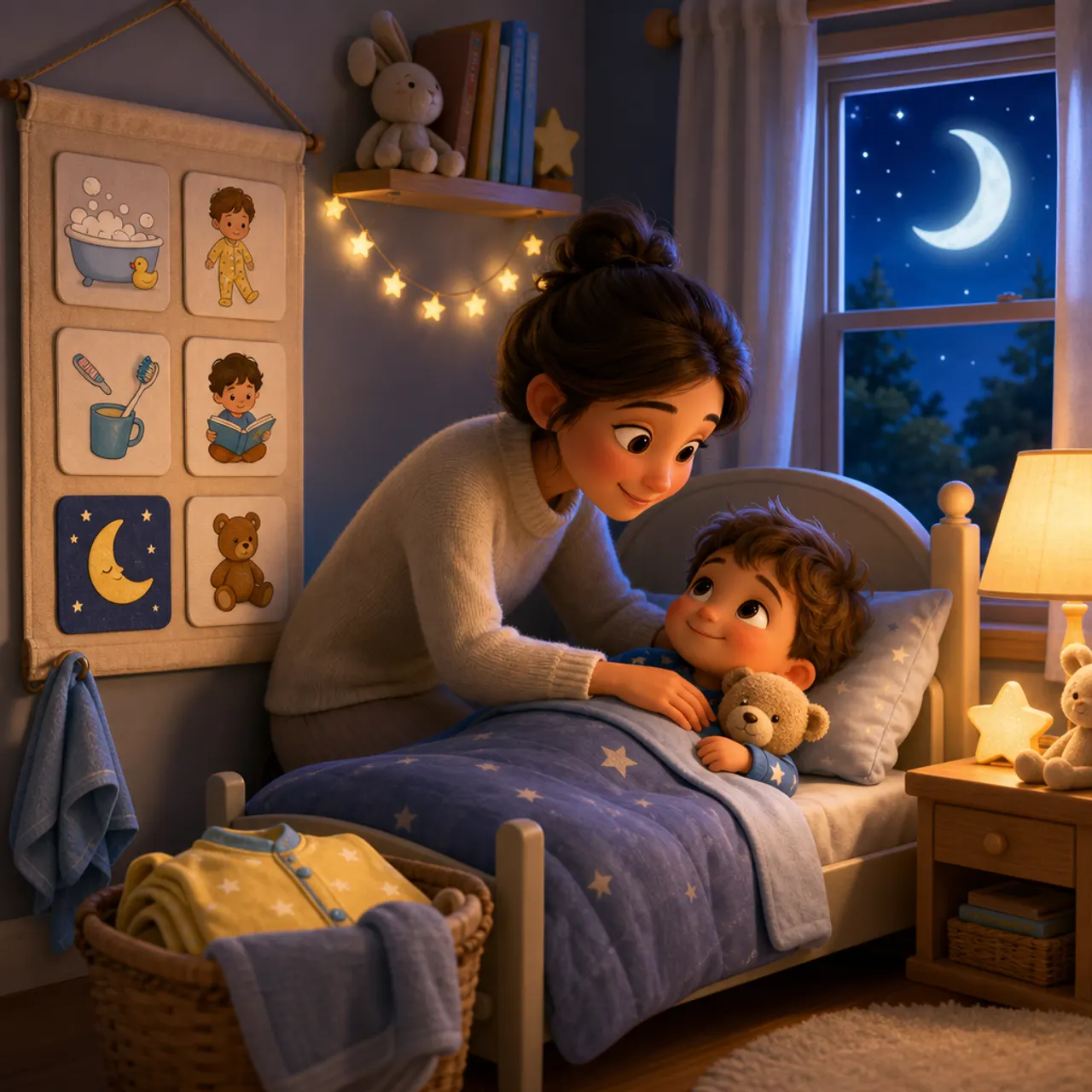
- Visual routine chart. Four or five pictures on the wall — bath, teeth, pajamas, story, bed. Sounds cheesy. Works absurdly well. It shifts the authority from “Mom said” to “the chart says,” which is much harder to argue with.
- Give choices inside the routine, not about it. “Do you want the blue pajamas or the dinosaur ones?” is a great question. “Do you want to go to bed?” is a trap you set for yourself.
- The two-book rule. Set it, name it out loud every time, hold it. “Two books, then lights out.” Consistency here buys you years of peace later. I promise.
- Same room, same order. Toddlers are little continuity editors. They notice everything.
What doesn't:
Negotiating. The second you extend to a third book because tonight was rough, you've taught them that rough nights get bonus books. They are excellent at learning this. Better than they are at, say, using a fork.
4–5 years: the imagination shows up (for better and worse).
This is a genuinely magical age for bedtime and also the age when the monsters arrive.
Around four, kids develop enough imagination to build entire worlds in their heads — and enough to populate the closet with something with teeth. The same brain that loves a good story is the one that can't stop thinking about what's under the bed. You don't get one without the other.
What works:
- Longer story time, shorter everything else. Kids this age can sit for a real story with an actual arc. Lean into it. Trim the fussing around and give the extra ten minutes to the book — it's the part that's doing the most work.
- Talk about the day first. Two minutes of “what was the best part of today?” before the story. Kids this age lie awake processing stuff they didn't get to say out loud. Give them somewhere to put it.
- Take the fears seriously, then be boring about them. Not “there's no such thing as monsters” (which reads as you don't believe me). Try “I know that feels really real. This room is safe, I'm right down the hall, and I'm going to check on you in ten minutes.” Then actually check on them. Reliability beats reassurance.
- A stuffed animal with a job. Not just a friend — a guard. Give it a title. Kids take this extremely seriously and it helps.
What doesn't:
Screens in the last hour. I know. I know. But it's not just the blue light — it's that a fast-cut video leaves a four-year-old's brain revved up and jangly at exactly the moment you need it settling. A story does the opposite.
6–7 years: they can read, so read to them anyway.
Here's the mistake almost everybody makes: your kid learns to read, so you stop reading to them.
Don't. This is the single most common bedtime regret I hear from parents of older kids.
A six-year-old can decode words on a page, but their listening comprehension is years ahead of their reading level. When you read aloud, you can give them a story that's actually interesting — real vocabulary, real stakes, real jokes — instead of whatever they can sound out themselves. And you keep the ten minutes of closeness that they will, at some point, stop asking for.
What works:
- Chapter books. One chapter a night. The cliffhanger becomes the incentive — they'll get in bed faster to find out what happens.
- Let them push bedtime later, formally. A 6:30 lights-out for a seven-year-old is going to be a fight. Move it to 7:45 and make the last twenty minutes reading. You've traded a battle for a ritual.
- Alternate who reads. They do a page, you do a page. Keeps their skills up without turning story time into homework.
- Protect the wind-down. Homework, sports, screens — this age gets busy, and bedtime is the first thing to get squeezed. Guard it like an appointment.
What doesn't:
Treating reading time as a reward you can revoke. The second story time becomes leverage in a discipline conversation, you've taught them that books are conditional. Find something else to take away.
The thing that matters more than any of this.
Every routine above works for the same underlying reason, and it isn't the bath or the chart or the two-book rule.
It's that the same thing happens, in the same order, with the same person, on a night when everything went great and on a night when everything fell apart. Kids don't calm down because the routine is clever. They calm down because it's predictable, and predictable means safe.
Which is honestly good news, because it means you don't need to get it right. You just need to get it repeatable.